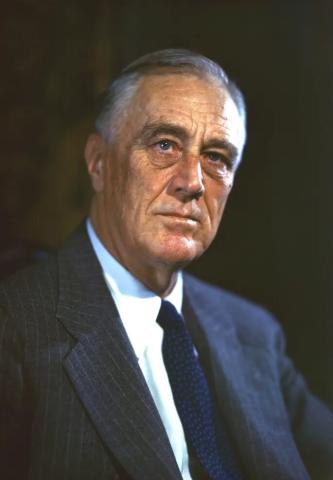
Amendment Twenty-two to the Constitution was ratified on February 27, 1951. It establishes term limits for elected presidents. It also clarifies and codifies the eligibility of succession for unfinished presidential terms. The official text is:
No person shall be elected to the office of the President more than twice, and no person who has held the office of President, or acted as President, for more than two years of a term to which some other person was elected President shall be elected to the office of President more than once. But this Article shall not apply to any person holding the office of President when this Article was proposed by Congress, and shall not prevent any person who may be holding the office of President, or acting as President, during the term within which this Article becomes operative from holding the office of President or acting as President during the remainder of such term.
This article shall be inoperative unless it shall have been ratified as an amendment to the Constitution by the legislatures of three-fourths of the several States within seven years from the date of its submission to the States by the Congress.
The question of term limits for elected officials began with the first debates surrounding the Constitution’s ratification. Under the Articles of Confederation, the office of President did not exist. Legislative and executive power was centered in the legislature. This proved unworkable and so establishing a true executive branch became part of the debates over creating the U.S. Constitution. The Framers differed in how the executive (the President) would be elected, and for how long. Alexander Hamilton and James Madison envisioned a president who would be nominated by the Congress to serve for life, raising concerns that the United States would turn into an “elective monarchy.” Other proposals for presidential terms were also met with skepticism. The final solution was to have eligible citizens vote for the president through the Electoral College system, and the prospective president-elect would not be bound by term limits.
The decision by our first president, George Washington, to voluntarily step down from office after two terms, established an unofficial tradition for future presidents to serve for no longer than two terms. For the next one hundred and fifty years, this system seemed to sustain itself with little to no trouble. Both President Ulysses Grant and President Woodrow Wilson wished to run for a third term but they were not nominated at their party conventions. President Theodore Roosevelt lost his bid for a non-consecutive third term against Wilson in the 1912 election. It was the unique circumstances of the 20th century that would raise greater questions regarding term limits.
Franklin D. Roosevelt was elected in 1932 by American voters hoping for strong leadership to handle the Great Depression. He then served two terms. Facing the looming threat of U.S. involvement in the second World War and lingering problems from the Great Depression, Roosevelt chose to run again in the 1940 election to maintain stability in leadership for the country. The American voters endorsed this stability, and Roosevelt was elected to a third term. He was elected for a fourth term in the 1944 presidential election and served as president until his death in April 1945. This unprecedented four terms, 13 years of serving as President, raised serious concerns about executive overreach.
After the 1946 mid-term election, Republicans took control of both the House and the Senate and very soon after the House of Representatives proposed Joint Resolution 27, calling for a set limit of two terms, each containing four years, for all future presidents. After going through some revisions by the Senate, the proposed amendment was approved and sent out to the states for ratification on March 21, 1947. The proposed amendment, now officially adopted as the Twenty-second Amendment, was ratified in 1951 after almost four full years of deliberation.
Since the new amendment’s ratification, all subsequent presidents have served for no longer than two elected terms. Several attempts have been made by presidents and Congress members of many different political affiliations to either modify or outright repeal the Twenty-second Amendment. Arguments in favor of repealing the amendment have ranged from having consistent leadership in response to a crisis, to allowing non-consecutive terms for eligible presidents with longer life expectancies. There also remains some controversy about how the Twenty-second Amendment and the Twelfth Amendment interact on the issue of a former two-term President possibly serving as Vice President.