Educational Activity
Activity Type: Making Connections. Analyzing Documents, Finding a Sequence
Thinking Skills: Order of Events, Historical Understanding, Historical Analysis & Interpretation
Blooms Taxonomy: Understanding (Explaining Ideas or Concepts), Analyzing (Making Connections Among Ideas)
Grade Level: Middle School, High School, College/University
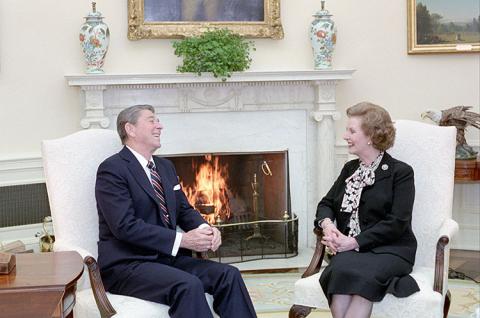
Americans seek always to make friends of old antagonists. After a colonial revolution with Britain, we have cemented for all ages the ties of kinship between our nations.
PRESIDENT RONALD REAGAN
Remarks and a Question-and-Answer Session With the Students and Faculty at Moscow State University
May 31, 1988
Historical Background
Great Britain established thirteen colonies in North America along the Atlantic coast beginning with Jamestown in 1607 and continued to expand until 1733 when the colony of Georgia was established. Disputes over taxation, lack of representation in the British Parliament, and individual rights, led to the American Revolution (1765-1783). The Treaty of Paris signed on September 3, 1783, ended the War of American Independence, and recognized the Thirteen Colonies as free and independent. While Great Britain recognized U.S. independence with the 1783 Treaty of Paris, maritime disputes led to the War of 1812. As a young nation the United States had only sixteen warships and was unable to directly challenge the British Royal Navy’s fleet of five hundred ships. The conflict ended after the Treaty of Ghent was ratified by the U.S. Congress on February 17, 1815.
Despite tensions during the American Civil War, the relationship between Great Britain and America grew during the 19th century as both economic and cultural ties strengthened. The U.S. economy eclipsed Britain’s by the late 1880s and by the 1920s New York had surpassed London as a global financial center. The two countries were allies during World Wars I and II. After WWII, the two nations developed even closer ties as military allies, members of the North Atlantic Treaty Organization (NATO), and the Group of Seven (G7) intergovernmental economic forum. This bond grew even stronger during the 1980s, anchored by the close political and personal friendship between President Ronald Reagan and British Prime Minister Margaret Thatcher.
- After reading President Reagan’s letters to both Prime Minister Margaret Thatcher and Queen Elizabeth II, what do you learn about the President's role in diplomacy?
- Read Thatcher's correspondence to President Reagan. What is she discussing with the President?
- In your own words, write a description for the National Security Council (NSC). What is the purpose of the NSC? Who are the members of the NSC? What year was the NSC established? Historically, what was happening in the world when the NSC was established?
- In your own words, describe the Situation Room. Where is the Situation Room located? What is the purpose of this facility? Which U.S. President established the Situation Room? What was the event that caused the President to create the Situation Room?
- Why do you think Thatcher’s letter to President Reagan was sent through secret channels? What was the security level assigned to Thatcher’s letter? When was this letter declassified by the National Archives & Records Administration (NARA)?
- Why do you think the White House Situation Room and the National Security Council had a hold of these letters and drafted President Reagan’s response?
- What do these letters tell you about the relationship between the United States & Great Britain during this era?
Primary Source Documents: Prime Minister Margaret Thatcher to President Ronald Reagan
Primary Source Document: Letter to Queen Elizabeth II from President Ronald Reagan
- What do you observe about President Reagan’s letter to Queen Elizabeth II?
- The British Royal Family is a constitutional monarchy, and therefore the Queen of England is a ceremonial Head of State with limited powers. Knowing this, why do you think President Reagan cultivated such a close diplomatic relationship with the Queen?
- Look back at the letter, what did these two world leaders exchange? What hobby do they have in common?
- What happened during the Queen's visit to California? Where did President Reagan meet with the Queen? Why do you think the President chose this location?
- What did President Reagan hope for between himself and the Queen as world leaders?
Standards Aligned Content:
California History-Social Science Standards:
- HSS 8.3
- HSS 8.11
- HSS 11.9
- HSS 11.11
- HSS 12.4
College, Career, and Civic Life (C3) Framework Standards:
- D2.Civ.1.3-5 ,D2.Civ.1.6-8, D2.Civ.1.9-12
- D2.Civ.10.9-12
- D2.His.1.6-8, D2.His.1.9-12
- D2.His.5.9-12
- D2.His.11.3-5, D2.His.11.6-8, D2.His.11.9-12
Educating for American Democracy Roadmap:
- Theme 4 : A New Government and Constitution
- Theme 6: A People in the World