Educational Activity
Activity Type: Mapping History Analyzing Documents Seeing the Big Picture
Thinking Skills: Order of Events Historical Understanding Historical Issues - Analysis & Decision-Making
Blooms Taxonomy: Understanding (Explaining Ideas or Concepts) Analyzing (Making Connections Among Ideas)
Grade Level: Middle School, High School, College/University
Deterrence is essential to preserve peace and protect our way of life, but deterrence is not the beginning and end of our policy toward the Soviet Union. We must and will engage the Soviets in a dialog as serious and constructive as possible -- a dialog that will serve to promote peace in the troubled regions of the world, reduce the level of arms, and build a constructive working relationship.
PRESIDENT RONALD REAGAN
Address to the Nation and Other Countries on United States-Soviet Relations
January 16, 1984
Historical Background
The United States and Russia have shared a complex relationship for more than two centuries. During the American Revolutionary War, Empress Catherine the Great issued the Declaration of Armed Neutrality and sponsored mediation efforts between Britain and its rebellious colonies. Motivated by the fur trade, Russia began colonizing Alaska in the 1740s, establishing the Russian-American Company to govern its Alaskan territories. From 1812 to 1841 the two nations even shared a land border when the Russian-American Company established Fort Ross in California. Located on the Sonoma County coastline, Fort Ross was a commercial and agricultural hub intended to supply food to the Alaskan colonies.
In 1867, Russia sold Alaska to the United States for $7.2 million or approximately two cents an acre. U.S. Secretary of State William Seward brokered the sale and faced criticism for the purchase. It was mocked as "Seward's Folly" and "Seward's Icebox," mostly because prevailing public opinion viewed Alaska as a frozen wasteland. During WWI Russia sided with Britain, France, and Serbia (Allied Powers) against Germany and Austria-Hungary (Central Powers). The United States remained neutral until 1917, supplying Russia, Britain and other allies. Within Russia, the February Revolution of 1917 ousted Tsar Nicholas II ending the Romanov dynasty. After the Bolshevik Revolution in October 1917, Russia exited WWI by signing the Treaty of Brest- Litovsk with the Central Powers. The Russian Civil War lasted from 1917 to 1922. In 1918 President Woodrow Wilson sent approximately 13,000 U.S. troops to Russia. The U.S. Troops were divided into two groups. The North Russia Expeditionary Force nicknamed the "Polar Bears," numbered 5,000 and engaged in heavy fighting with the Bolsheviks. While the American Expeditionary Force Siberia numbered 8,000 and mainly guarded the Trans-Siberian Railway. The intervention damaged U.S.-Soviet relations and U.S. Forces withdrew by April 1920.
The Bolsheviks would eventually define themselves as the Communist Party of the Soviet Union. The United States did not formally recognize the Soviet Union until 1933. Despite their differences during WWII, the United States and Russia were allies. At the end of WWII, both nations emerged as global superpowers with nuclear arsenals. Relations between the two countries shifted from alliance to rivalry. The Cold War became a decades-long struggle for supremacy marked by ideological differences, economic influence, technological rivalries such as the Space Race, proxy wars, espionage, embargoes, boycotts, and an arms race in both conventional and nuclear weapons.
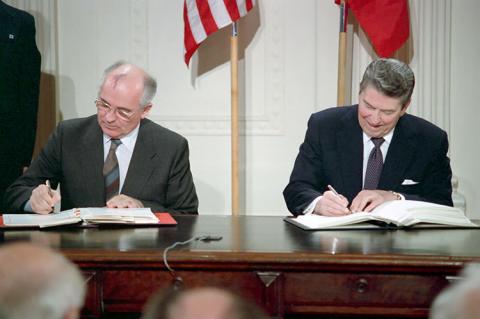
On December 8, 1987 President Ronald Reagan and Soviet General Secretary Gorbachev signed the Intermediate-Range Nuclear Forces (INF) Treaty in the East Room of the White House. The INF treaty marked the first time the superpowers agreed to reduce their nuclear arsenals by eliminating an entire class of weapons. With the INF Treaty, the Soviet Union and the United States deactivated all short- and intermediate-range land-based ballistic and cruise missiles. These weapons can carry nuclear warheads. The treaty established new protocols for verification. Observers from each nation verified the destruction of the arsenals.
From the Office of President Reagan to President Brezhnev
- Looking at the memo that Richard V. Allen sent to President Reagan on September 19, 1981, what information can you gain from the memorandum for the President?
- Richard Allen’s memo to the President originally had what level of classification and why?
- When you look at Richard Allen’s secret memo to the President and the attached letter, what do you learn about the office of the Presidency?
- Who was Alexander Haig?
- Reading this letter, what inferences can you make about the relationship between the Soviet Union and the United States at the time?
Suggested Letter from President Reagan to President Brezhnev
From the Office of President Reagan to General Secretary Gorbachev
Letter from President Reagan to General Secretary Gorbachev
- Analyze the tone of President Reagan's letter to Gorbachev. How would you describe his tone?
- What insight into diplomatic relations does this letter give you?
- What are the main points of the proposal detailed in President Reagan's letter to Gorbachev?
- What are the compromises President Reagan discussed in the letter?
- Compare and contrast the letters to Gorbachev and Brezhnev. How are they similar and/or different?
- When reading the letters to General Secretary Brezhnev and General Secretary Gorbachev, did President Reagan shift his tone or policy positions? If so, how did it change?
- When you read both the memos and the letters, what do you learn about the work of the National Archives and Records Administration?
Standards Aligned Content:
California History-Social Science Standards:
- 11.11.2
- 12.4.4
College, Career, and Civic Life (C3) Framework Standards:
- D2.His.1.6-8, D2.His.1.9-12
- D2.Civ.14.6-8, D2.Civ.14.9-12
- D3.1.6-8, D3.1.9-12
Educating for American Democracy Roadmap:
- Theme 5: Institutional & Social Transformation
- Theme 6: A People in the World