Educational Activity
Activity Type: Mapping History Compare and Contrast Weighing the Evidence
Thinking Skills: Historical Issues - Analysis & Decision-Making Historical Understanding
Blooms Taxonomy: Understanding (Explaining Ideas or Concepts) Evaluating (Justifying a Position or Decision)
Grade Level: Middle School, High School, College/University
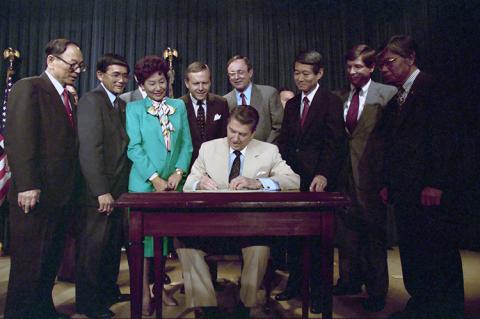
The Members of Congress and distinguished guests, my fellow Americans, we gather here today to right a grave wrong. More than 40 years ago, shortly after the bombing of Pearl Harbor, 120,000 persons of Japanese ancestry living in the United States were forcibly removed from their homes and placed in makeshift internment camps. This action was taken without trial, without jury. It was based solely on race, for these 120,000 were Americans of Japanese descent
PRESIDENT RONALD REAGAN
Remarks on Signing the Bill Providing Restitution for the Wartime Internment of Japanese-American Civilians
August 10, 1988
Historical Background
During the 1930s, prior to the outbreak of WWII, both the Office of Naval Intelligence and the Federal Bureau of Investigation (FBI) conducted surveillance on Japanese Americans. When Japan bombed the U.S. Pacific Fleet at Pearl Harbor on December 7, 1941, there were approximately 120,000 people of Japanese ancestry living on the U.S. mainland, mostly on the Pacific Coast. In the aftermath of Pearl Harbor, fear combined with Japan’s recent military victories in the Philippines, Guam, and Malaya, caused a wave of near hysteria. Faced with mounting pressure from both the public and U.S. military leaders, President Roosevelt issued Executive Order 9066 on February 19, 1942. The order authorized Secretary of War Henry L. Stimson to remove anyone deemed a threat from the West Coast. The order caused the sudden forced removal and incarceration of Japanese Americans. Sparking both constitutional and political debate.
During this era, three Japanese American citizens challenged the constitutionality of E.O. 9066 and the various curfew orders enacted. Gordon Hirabayashi, Fred Korematsu, and Mitsuye Endo had mixed results for their legal efforts. Hirabayashi and Korematsu received negative decisions, but after a lengthy battle through the lower courts, Ms. Endo was found to be “loyal” to the United States and released from the Topaz Utah facility. During their incarceration, Japanese Americans lost an estimated $400 million in property. In 1948 Congress provided $38 million in reparations but many inequities remained. In 1988, Congress passed Public Law 100-383-the Civil Liberties Act of 1988. President Reagan signed P.L. 100-383 on August 10, 1988. The law provided a formal government apology and $20,000 in compensation for each survivor. Over 82,000 Japanese Americans received payments totaling more than $1.6 billion.
Yet we must recognize that the internment of Japanese-Americans was just that: a mistake. For throughout the war, Japanese-Americans in the tens of thousands remained utterly loyal to the United States. Indeed, scores of Japanese-Americans volunteered for our Armed Forces, many stepping forward in the internment camps themselves. The 442d Regimental Combat Team, made up entirely of Japanese-Americans, served with immense distinction to defend this nation, their nation. Yet back at home, the soldiers' families were being denied the very freedom for which so many of the soldiers themselves were laying down their lives.
PRESIDENT RONALD REAGAN
Remarks on Signing the Bill Providing Restitution for the Wartime Internment of Japanese-American Civilians
August 10, 1988
Letters of Support from Constituents on the topic of Japanese Reparations
- What is Christine C. Schnusenberg’s suggestion to President Reagan regarding Japanese reparations?
- Based on reading Schnusenberg’s letter, identify other countries that have provided reparations and explain the reasons why.
- Why does Schnusenberg encourage the President to issue a Presidential Order for reparations? From this letter, what can you infer about the powers of the presidency and presidential orders?
- In addition to reparations for Japanese-Americans, what other topic is Christine Schnusenberg concerned about?
Letter from Christine C. Schnusenberg to President Reagan
Letter from Deputy Kimberly D. Hall to President Reagan
- Who sent the Los Angeles City Council's motion to President Reagan?
- Why did the City Council of Los Angeles adopt this motion and send it to President Reagan?
- Consider the various levels of government, who has already issued reparations to Japanese-Americans from World War II?
- From this adopted motion, what do you learn about the powers held by each layer of government and their interactions (city, county, state, and federal)?
- Why do you think Ms. Hall sent this letter to President Reagan?
- After the White House received this letter, where was it sent and why?
Letters from Constituents Against Japanese Reparations:
- During World War II, what did Lloyd Buchanan do professionally and where did he work?
- Including Buchanan, how many attorneys were polled about the legality of the order? Do you believe a group of that size is sufficient to address the legality of the President’s order to remove Japanese-Americans? Why or why not?
- According to Buchanan, when the attorneys were surveyed on the legality of President Roosevelt's Executive Order 9066, what was the result?
- What Supreme Court decision is Buchanan referring to in his letter?
- During the war, how did Buchanan interact with interred Japanese Americans?
- What is Buchanan’s position on reparations for Japanese-Americans? What reasons does he give to support his position?
Letter from Judge Lloyd Buchanan to President Reagan
Letter from Alex Leitch
- What is Alex Leitch’s position on reparations to Japanese Americans?
- What reasons does Leitch give for his position?
- How does Alex Leitch define the word ‘interred’ in this letter?
- What point does Leitch make about the Filipino and US servicemembers who survived the Bataan Death March?
- From World War II to present day, how has military enlistment changed in the United States?
Standard Aligned Content:
California History-Social Science Standards:
- 11.7.5
- 12.7.2
- 11.7.3
- 12.4.4
College, Career, and Civic Life (C3) Framework Standards:
- D2.Civ.3.9-12
- D2.Civ.10.9-12
- D2.Civ.14.9-12
- D2.His.6.9-12
- D3.3.9-12
Educating for American Democracy Roadmap:
- Theme 2: Our Changing Landscapes
- Theme 4: A New Government and Constitution
- Theme 5: Institutional & Social Transformation