Educational Activity
Activity Type: Making Connections Analyzing Documents Mapping History
Thinking Skills: Historical Issues - Analysis & Decision-Making Historical Understanding Historical Analysis & Interpretation
Blooms Taxonomy: Evaluating (Justifying a Position or Decision) Understanding (Explaining Ideas or Concepts) Analyzing (Making Connections Among Ideas)
Grade Level: Middle School, High School, College/University
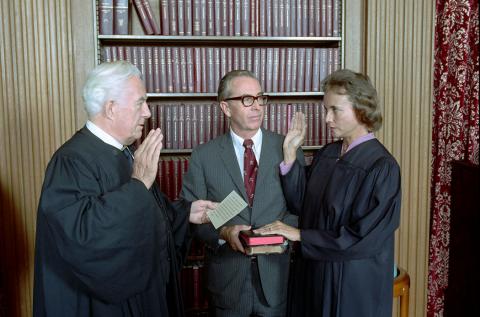
She [Sandra Day O’Connor] is truly a person for all seasons, possessing those unique qualities of temperament, fairness, intellectual capacity, and devotion to the public good which have characterized the 101 brethren who have preceded her. I commend her to you, and I urge the Senate's swift bipartisan confirmation so that as soon as possible she may take her seat on the Court and her place in history
president Ronald reagan
Remarks Announcing the Intention To Nominate Sandra Day O'Connor To Be an Associate Justice of the Supreme Court of the United States
July 7, 1981
Historical Background
A hallmark of leadership is the ability to create new pathways. During the 1980 presidential campaign, Ronald Reagan pledged to appoint the first woman to the U.S. Supreme Court. On October 14, 1980, during a campaign stop in Los Angeles, Reagan stated, “It is time for a woman to sit among our highest jurists,” pledging to appoint a woman to “one of the first Supreme Court vacancies in my administration.” When Justice Potter Stewart retired in 1981, President Reagan fulfilled his campaign promise by nominating Sandra Day O’Connor on August 19, 1981. At the time of her nomination O’Connor was serving as a judge for the Arizona Court of Appeals. She had achieved career distinction by serving in all three branches of Arizona’s state government.
First as an Assistant Attorney General (1965-1969) for the executive branch, then as a State Senator (1969-1975) for the legislative branch, and then for the Judicial branch, first as a judge on the Maricopa County Superior Court (1975-1979) followed by the Arizona Court of Appeals (1979-1981). O’Connor’s confirmation hearing before the Senate Judiciary Committee lasted three days and was the first televised confirmation hearing for a Supreme Court nominee in the United States. On September 21, 1981, the full Senate voted to confirm O’Connor with a vote of 99-0. Senator Max Baucus of Montana was absent from the vote. He sent O’Connor a copy of the novel, A River Runs Through It, as an apology. Four days after being unanimously confirmed by the Senate, O’Connor took her seat on the Bench.
Her appointment ushered in a new era. She was addressed as Her Honor, and notably, there was initially no women’s restroom near the Courtroom. During her first year, O’Connor received more than 60,000 letters from the public. More than any other justice in history. In October 1983, the New York Times published an editorial referring to the “nine men” of the Supreme Court. O’Connor responded by sending a letter to the editor, reminding the newspaper, that the Court was no longer composed of nine men and referring to herself as FWOTSC-First Woman on the Supreme Court. In 1993, when Ruth Bader Ginsburg became the second female Supreme Court justice, O’Connor expressed relief that she was no longer the only woman. Sonia Sotomayor became the third woman to serve on the Supreme Court in 2009.
When Elena Kagan was nominated by President Obama in 2010, O’Connor spoke about the “dreadful, unpleasant” process of confirmation hearings. Sandra Day O’Connor served on the Supreme Court for 25 years. As a moderate she was often the deciding vote on many cases and disdained the “swing vote” label given to her by the press. O’Connor authored 676 opinions, 301 of which were the Opinion of the Court. When O’Connor joined the Supreme Court in 1981, thirty-six percent of law students in the United States were women. When she retired from the Court in 2006 that percentage had increased to forty-eight percent. By any measure, it was a truly remarkable career, especially considering that when O'Connor graduated near the top of her law school class in 1952, no law firm was willing to hire her.
Letter from Sarah Harder to President Reagan
Letter from Sandra Day O'Connor to President Reagan
- According to the letter, what is the position of the National Women’s Conference on President Reagan’s nomination of Sandra Day O’Connor to the Supreme Court?
- Who is Sarah Harder?
- In your own words write a brief description of the National Women’s Conference Committee and the goals of the organization.
- Read Sandra Day O’Connor’s letter to President Reagan. What do you learn by reading her letter? What pledge does she make?
- What campaign commitment did President Reagan fulfil by nominating Sandra Day O’Connor to the Supreme Court?
- According to both O’Connor and the National Women’s Conference Committee, President Reagan’s action was historic. What did this action accomplish and what was the impact for our Nation?
Letter from Gilder L. Wideman to President Reagan
- In your own words write a brief description of the Eagle Forum of Alabama and the goals of this organization.
- Who is Gilder L Wideman?
- According to the letter, what is the position of the Eagle Forum on the nomination of Sandra Day O’Connor to the Supreme Court?
- What reasons did the Eagle Forum of Alabama give for their position on O’Connor’s nomination?
- What is the Eagle Forum urging President Reagan to do?
- Looking at both letters, what do you learn about the powers of the Presidency and the challenges a President may face when filling a vacancy on the Supreme Court?
Standards Aligned Content:
California History-Social Science Standards:
- 11.11
- 12.7
- 12.4
College, Career, and Civic Life (C3) Framework Standards:
- D2.Civ.1.6-8, D2.Civ.1.9-12
- D2.Civ.10.6-8
- D2.Civ.14.6-8, D2.Civ.14.9-12
- D3.1.6-8. D3.1.9-12
Educating for American Democracy Roadmap:
- Theme 3: We the People
- Theme 4: A New Government & Constitution
- Theme 5: Institutional & Social Transformation